Arriving in Orchha

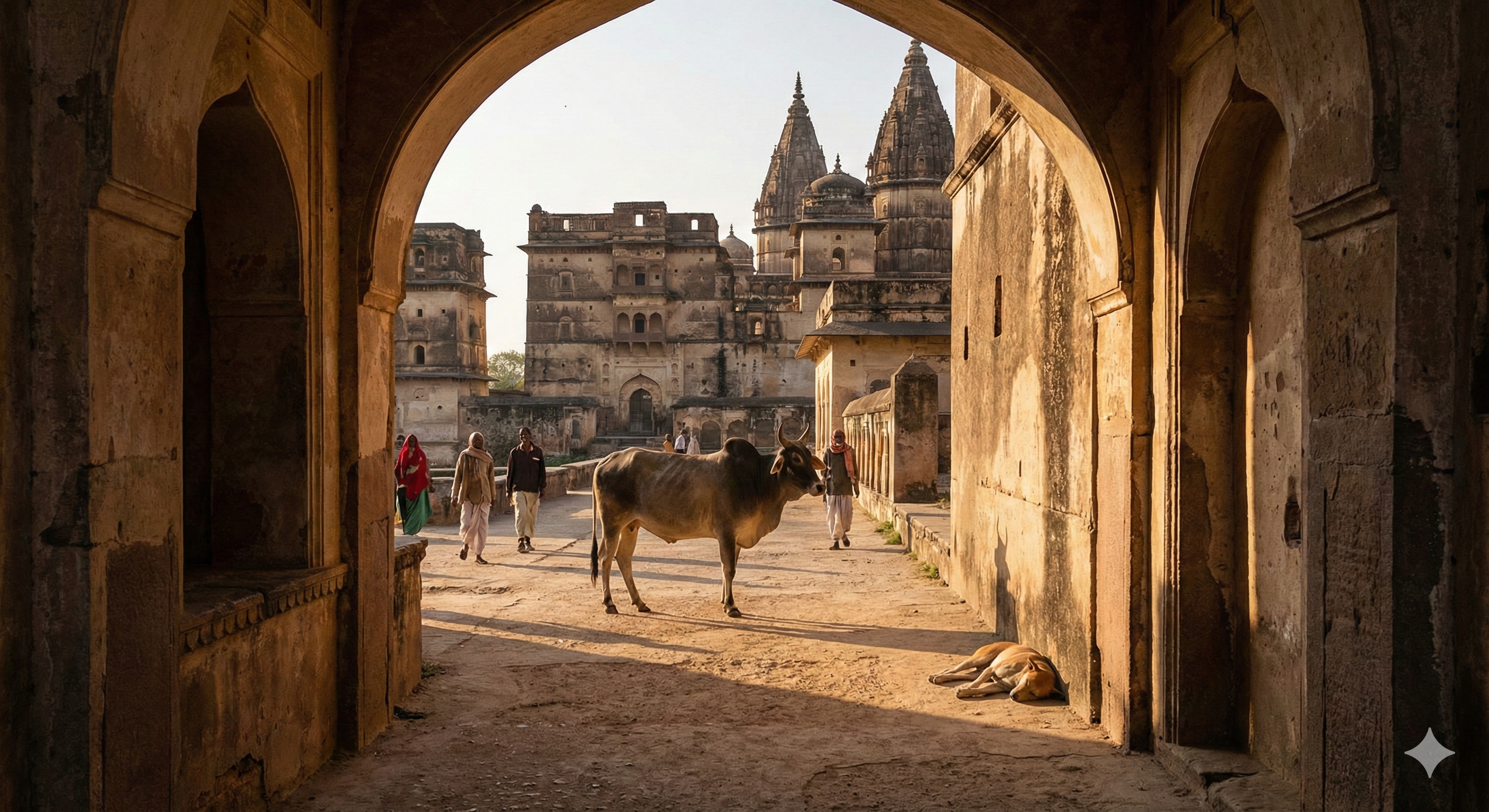
I arrived in Orchha without doing anything in particular, which seemed to be the correct way to arrive there. The road ended gently, as if unsure whether it ought to continue, and the town took over without announcement. I stood for a while under an arch whose purpose was no longer clear, except that it offered shade, which it did generously. A cow occupied the middle of the path and showed no intention of moving; I waited, and eventually discovered that waiting was not an interruption but the activity itself. The buildings did not face me so much as remain where they were, tall and uncurious, their stones holding the afternoon in place. Somewhere a temple bell rang, not insistently, more out of habit than devotion, and then stopped. I noticed that nothing here seemed eager to explain itself. The light shifted slowly along a wall, revealing marks that looked accidental until one realized they had been accumulating for centuries.
I took out my camera, then put it away, and then took it out again, not because the scene had changed, but because I had. People passed through the courtyards with the ease of those who know exactly where they are going and are in no hurry to get there. After some time—how much I could not say—I realized that Orchha was not asking to be seen, only allowing it. I stayed where I was, long enough for the idea of arrival to lose its meaning, and that seemed sufficient.
After that first pause, movement returned in small increments. A man crossed the courtyard carrying something wrapped in cloth, the contents of which were none of my concern. Two boys argued about nothing I could hear, their voices rising briefly before settling again into ordinary speech. A dog slept in the precise strip of shade cast by a wall, as if it had measured it in advance. The fort rose behind all this, vast but uninterested, like an elderly relative who has outlived the need to participate. I walked through its corridors without feeling that I was entering anything; the space simply adjusted to include me. Windows opened onto other windows, stairs led to platforms whose purpose was not immediately apparent, and from somewhere above came the sound of wind passing through an opening that had been cut long before anyone thought to ask why.
I found myself sitting more than walking. The stone steps were worn smooth, not from reverence but from repeated, unremarkable use. Sitting there, it became clear that the architecture was not meant to be read in a single direction. One looked, then stopped looking, then looked again. Light moved across surfaces without drama, and the day seemed content to be spent this way. I noticed that I was no longer thinking in terms of what remained to be seen. The fort did not present itself as a sequence of highlights; it allowed wandering and accepted incompletion.
Outside, the town arranged itself around the river with the same lack of urgency. Shops opened when they did. Tea appeared after some discussion, not because it was unavailable but because there was no reason to hurry it. The river moved past quietly, carrying reflections of temples that appeared unconcerned by their own symmetry. I stood at the ghats for a long time, watching people do what they had clearly done many times before—washing, talking, pausing mid-conversation to stare at the water. No one seemed to be performing an action for the sake of being seen doing it. Life here did not arrange itself into scenes; it unfolded.
Photography became a matter of patience rather than pursuit. I returned to the same corners repeatedly, not out of indecision but because the light insisted on revisiting them. A wall that had looked flat in the morning revealed depth by late afternoon. Shadows grew longer, then softened, then disappeared altogether. I took fewer photographs than expected, though I spent more time with the camera. It was not necessary to search for subjects; they arrived when they were ready. I noticed that waiting sharpened attention more effectively than movement ever had.
Evenings arrived early. The sky dimmed without ceremony, and the town adjusted accordingly. Conversations lowered their volume. Lamps came on in places that had not seemed to require them during the day. The temples did not dominate the darkness; they settled into it, outlines just visible enough to remind one of their presence. Sitting somewhere between the river and the fort, I realized I had stopped marking time entirely. Meals happened when hunger insisted. Sleep came without negotiation.
The people I encountered remained largely unelaborated, which felt appropriate. A shopkeeper asked where I was from and nodded when I answered, as if this confirmed something he already knew. A priest offered directions that were more descriptive than precise, involving trees, corners, and the absence of a certain wall. Children watched me briefly and then lost interest. Nobody lingered in my story, and I did not linger in theirs. The town seemed to prefer it this way.
By the third day—though it might just as easily have been the second or fourth—I understood that Orchha does not reward curiosity in the usual sense. It offers no sudden revelations, no moments that insist on being remembered. What it provides instead is continuity. Things happen at the pace they have always happened, and one is free to align oneself with that rhythm or resist it. Resistance feels unnecessary. I noticed that my own movements had become less deliberate. I walked without planning routes, sat without justifying the pause, and left spaces without feeling that something had been missed.
Leaving was similarly uneventful. The road resumed where it had paused earlier, and the town receded without comment. There was no sense of conclusion, only the quiet understanding that whatever had been happening there would continue, uninterrupted. I carried no lessons with me, only a faint adjustment in pace. Days afterward, I caught myself waiting more often than usual—at crossings, at doorways, at moments that did not strictly require it. Orchha had not followed me, but the habit of not hurrying had, and I found no reason to correct it.