Room 11:43 Chapter Four — The Anatomy of a Fracture

The city did not know about Room 11:43, and its ignorance had begun to press against Mira in ways she could not easily articulate. It wasn’t that she expected the world to acknowledge what happened on the eleventh floor; it was that the world continued so carelessly, as though nothing precise or measured existed within it. From the kitchen window she watched a bus arrive late and depart half empty. Two men argued over something trivial near the entrance to the building. A child dragged a stick along the railing, producing a metallic scrape that rose and fell without rhythm. The sounds overlapped without coordination. Nothing resolved. Nothing aligned.
Inside the apartment, everything held its place. The refrigerator hummed at a consistent pitch. The stove clock marked time with its amber pulse. The rent had cleared three days earlier. The electricity had not faltered. At 15:01 each afternoon, the transfer arrived with mechanical punctuality. The regularity had stopped feeling like relief. It felt architectural, as though each payment reinforced the walls around her.
Abhi sat at the table behind her, the lights still off. They had grown used to the dimness. The overhead bulb cast shadows that were too sharp, too reminiscent of fluorescent glare and stainless steel surfaces. Darkness blurred edges and made things less declarative.
“You moved before the hinge,” he said quietly.
Mira did not turn around. She continued drying her hands on the frayed dish towel, smoothing its worn edges between her fingers. “I knew when it would open,” she replied.
“That isn’t what I meant.”
She understood what he meant. She had felt it herself: the way her body had begun to anticipate the intake of the door before it was fully visible, the way the hook had lifted into position without waiting for instruction. It had not felt impulsive. It had felt accurate, like stepping into the correct place in a pattern she had already memorized.
“It makes the sequence cleaner,” she said.
Abhi let the word linger in the air between them.
Later, lying beside him in the dark, she allowed the memory she had been avoiding to surface. She did not reconstruct the room in full. It appeared in her mind as measurements rather than images: distance from threshold to interception, angle of descent, the timing of the intake hatch. The room no longer felt like a place. It felt like a diagram she carried behind her eyes.
The girl entered during the third hour of the shift. Mira remembered that because the pace had already stabilised by then. Movements had compressed into efficiency. The hook intercepted without hesitation. The crowbar followed with minimal correction. Drag, pivot, intake. The hum beneath the floor had blended with the fluorescent buzz until it seemed part of her own breathing.
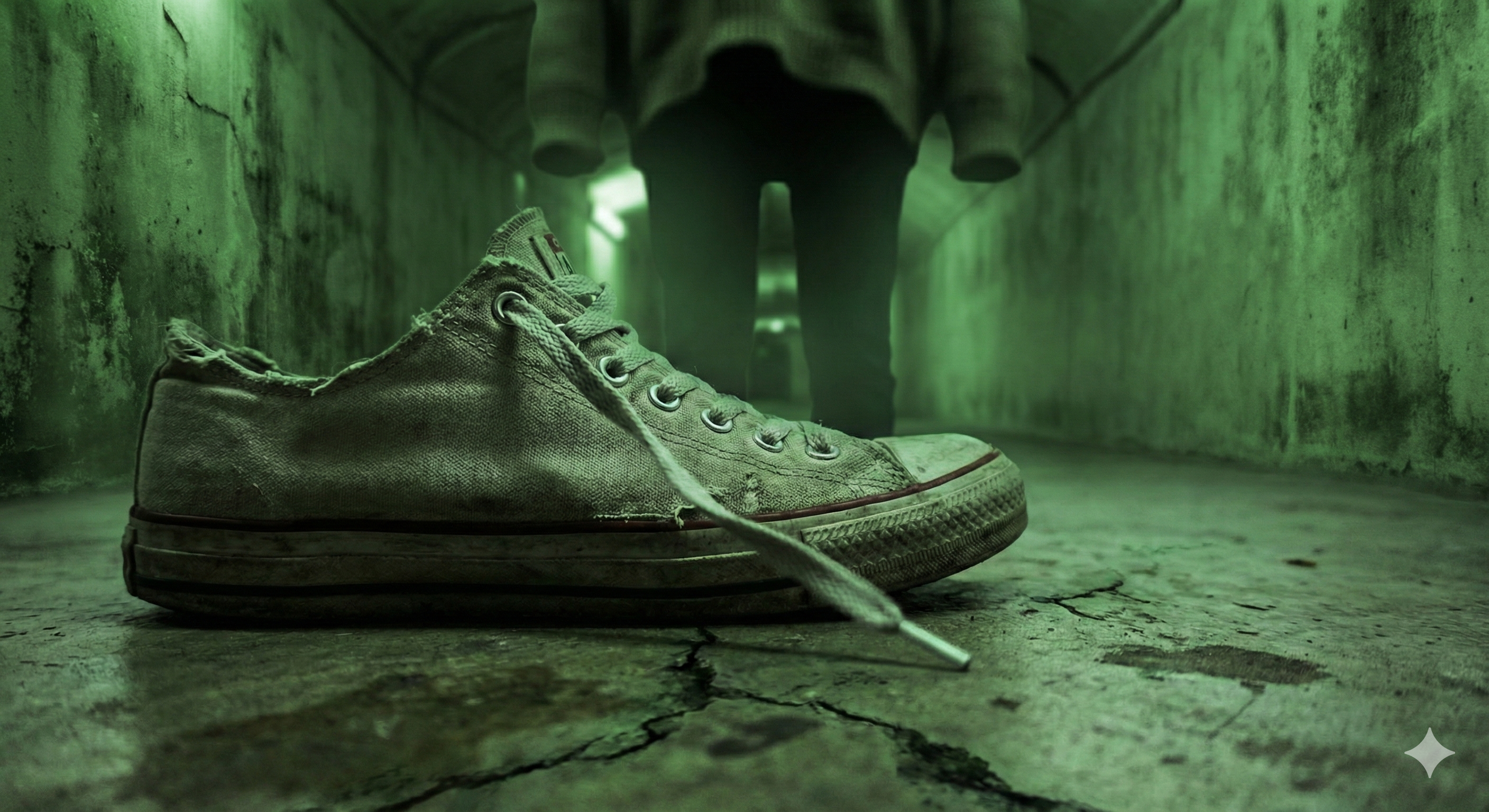
The girl had not moved like the others. There was no forward lean, no rigid inevitability to her steps. She crossed the concrete with a quiet steadiness that did not match the room’s geometry. An oversized sweater hung from her shoulders, slipping slightly at the collar. Her sneakers were worn thin at the edges.
It was the lace that caught Mira’s attention.
The left shoe was untied, and as the girl walked, the plastic tip struck the concrete with a small, intermittent sound. It was an ordinary sound, almost careless, the kind that belonged to mornings and doorways and lives not yet reduced to sequence. It did not belong on that floor.
Mira had already lifted the hook. She had already stepped into the arc. Yet her focus shifted. Instead of tracking the line of the girl’s movement, she watched the lace. She found herself waiting—for a stumble, a hesitation, some disruption that would intervene before she had to.
The girl did not look up. Her gaze remained fixed on the corridor door with a steadiness that was neither frantic nor resigned.
The delay lasted less than a second.
Behind Mira, the pen stopped moving.
She did not need to turn to know it had stopped. The absence of its motion changed the air. In that stillness, she understood that hesitation was measurable.
She corrected.
The hook caught the wool of the sweater and tore it. The crowbar descended in a clean, practiced arc that required no adjustment. The sound of the lace ceased.
“Consistent,” the woman said.
The pen resumed.
In the darkness of the bedroom, Mira tried to recall the girl’s face. It would not hold. The sweater remained vivid. The lace. The angle of her shoulders as she crossed the floor. The face dissolved each time she reached for it, as though it had never been necessary.
She turned onto her back and stared at the ceiling, tracing the uneven paint around the light fixture. Across the room, her own shoes rested by the door. She realized she had stopped tying them. The detail did not alarm her. It settled into place as something practical, efficient.
“Do you think they want one to get through?” she asked into the quiet.
Abhi was silent for a long time before answering.
“No,” he said finally. “I think they want to know if we will let one.”
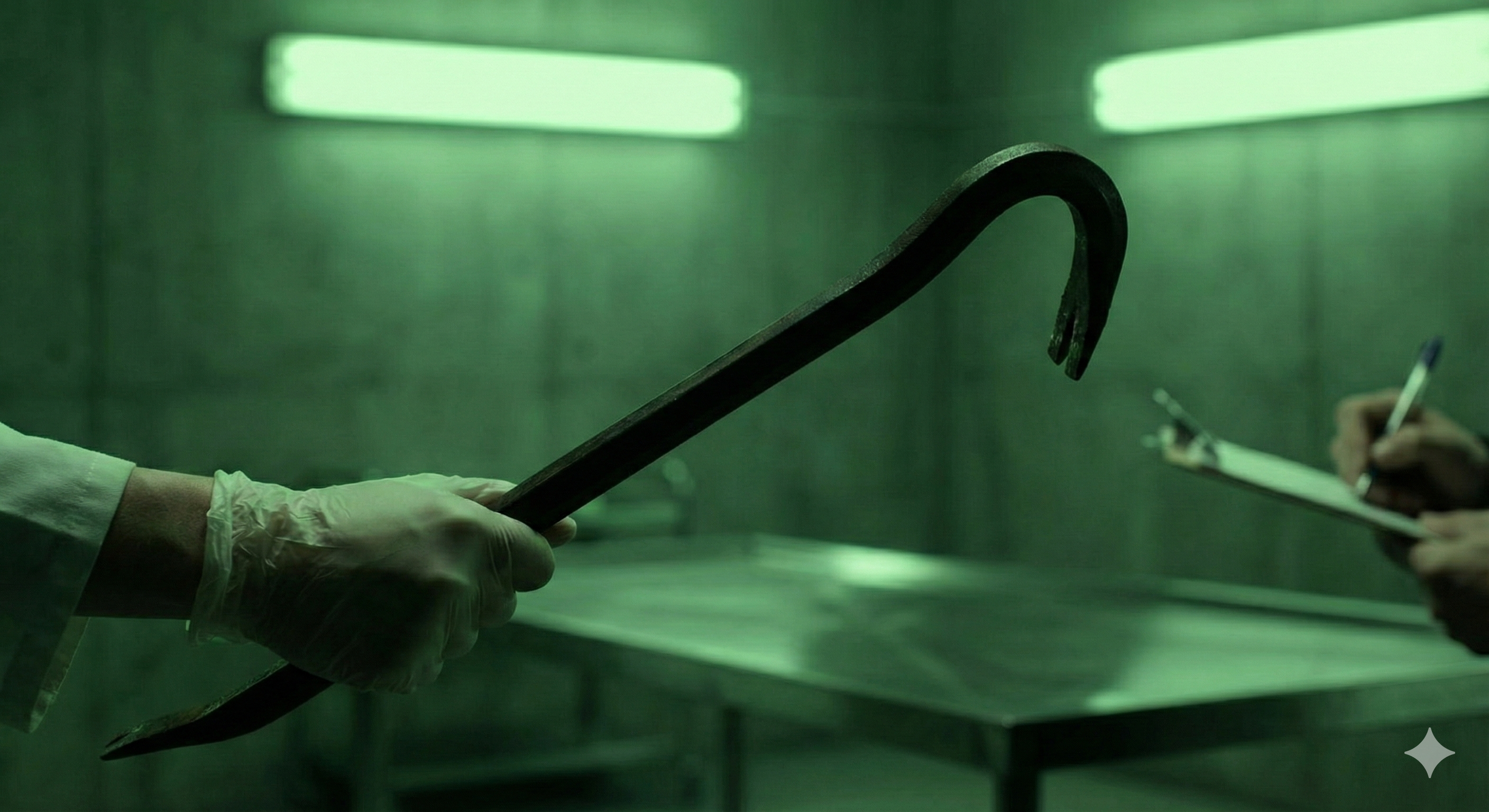
Mira lay still, listening to the steady hum from the kitchen. She imagined the stainless steel table at the far end of the room, the clipboard resting upon it, the pen balanced between fingers. She imagined watching instead of moving, measuring instead of intercepting. The image did not disturb her as much as it should have.
That was what lingered when the memory of the girl faded.
Not the strike.
Not the sound.
The realisation that she could occupy either position in the room and call it maintenance.
She closed her eyes and counted the hours until 09:00, not out of dread, but out of a quiet desire for the hinge to open at exactly the expected moment.
You should also read:
Room 11:43 Chapter Six — The Relocation
The building did not resist their deviation. When Mira and Abhi stepped off the elevator on the eleventh floor, the corridor was unchanged — the same muted green, the same low fluorescent hum. Room 11:43 waited at the far end, patient, rectangular, exact. They did…
Continue reading...
Room 11:43 Chapter Five — The Receipt of Terms
By the fourth week, Mira no longer counted the days. The rhythm of the shift had replaced the calendar. Five hours. Fifteen hundred seconds of clean interception. The hum beneath the floor. The stainless steel reflection. The silence of the table. The work had stopped…
Continue reading...
Room 11:43 Chapter Three — The Calibration
On the third morning, the hallway didn't feel like a tunnel. It felt like a lobby. Mira found her feet hitting the centre of the linoleum tiles with a precision that required no conscious thought. The fluorescent hum had moved from her ears to her…
Continue reading...