The Quiet Weight Of Orders - Part 3 of 4


As the afternoon light softened, the day seemed to slow around me, and the question that had accompanied me since morning began to take on a more contemporary shape. It no longer belonged only to the photograph or to the ancient stories that had drifted into my thoughts; it began to settle itself in the world I actually lived in — a world of governments, borders, televised speeches, strategic calculations, and the uneasy dance of nationalism and politics. The men who command armies today are not charioteers of the epic kind, nor philosophers in the manner of Socrates; they are, more often than not, politicians whose decisions are shaped by electoral maths, diplomatic pressures, and the perpetual need to appear decisive before a restless public. Their motives may occasionally align with justice, but just as often they spring from less stable terrain — insecurity, rivalry, ambition, or the simple desire to prove a point.
I found myself thinking about how easily the language of national pride can be used to mask the smallness of these motives. Borders become icons rather than lived spaces; people living along them become abstractions; and soldiers become symbols — convenient embodiments of strength, loyalty, or sacrifice, depending on what narrative the moment demands. It is a dangerous alchemy, for it transforms human beings into instruments of political performance. And yet, the soldier must obey. That is his training, his discipline, the very structure of his world. He is taught to respond to the authority above him, not to question it; taught to act swiftly, not to pause for philosophical reflection.
In the face of this reality, I began to sense more sharply the asymmetry that had been troubling me all day: the soldier bears the physical and moral burden of a command, while the commander bears only the authority of giving it. The risks are not shared. The hardships are not distributed. The fear, the cost, the grief — these accumulate at the bottom of the hierarchy, while the decisions that precipitate them are often made at the top with little personal consequence. This imbalance is not a theoretical concern but a living condition of modern power, and it casts a long shadow over the idea of obedience.
I watched a pair of villagers walk up the path with bundles of firewood on their backs, their conversation lost to the distance, and for a moment the ordinariness of the scene seemed to soften the edges of my thoughts. Yet even in that ordinariness I felt the quiet insistence of the question: how does one reconcile the purity of a soldier’s willingness to serve with the impurity that often accompanies the orders he must follow? The men in the photograph were prepared to endure hardship, to stand in harm’s way, to place their trust in a chain of command — but the worthiness of that command was not assured. And this, I realised, was the heart of the trouble: bravery, discipline, and honour can all be undermined if the direction in which they are applied is shaped by motives that are shallow, opportunistic, or morally unsteady.
The more I thought about it, the more I recognised that this dilemma extends beyond the battlefield. It is embedded in the very nature of institutions. Every institution requires a measure of obedience, of course; without it, coordination collapses and nothing functions. But the problem arises when obedience becomes an end in itself, valued more for its reliability than for the conscience that ought to accompany it. In such a setting, dissent becomes a threat rather than a resource. A questioning mind is seen as a liability. And the soldier, who must often learn to silence his inner voice for the sake of cohesion, gradually loses the habit of examining the moral quality of the orders he receives.
As these thoughts gathered, I felt a growing recognition that the world asks something difficult — perhaps impossible — of its soldiers: to remain moral while suspending their own judgement; to act decisively while questioning nothing; to serve a cause whose origins they have no hand in shaping. And this contradiction is sharpened in our time, when the causes that propel nations into conflict are no longer the stark, existential struggles of older eras but are instead woven from more ambiguous fibres — territorial posturing, geopolitical balancing, strategic messaging, resource disputes, or the political need to project strength. The soldier’s courage has remained constant, but the purposes into which it is placed have become increasingly complex, and not always honourable.
By the time the sun had dipped behind the ridge, leaving the sky to soften into evening, I understood that the photograph had not merely awakened a question; it had awakened a question that belonged not to the past but to the present. And the present offers no easy reassurance. It offers only the uneasy truth that soldiers must still obey, even when the authority they obey is fallible; still trust, even when that trust may be misplaced; still act, even when the reasons for action are tangled in the machinery of statecraft and political ambition. And as I stood watching the first lamps light up across the valley, I felt the weight of that truth settle into a deeper part of me, as if preparing itself for the reckoning that the evening would inevitably bring.
Continue to final part.
You should also read:
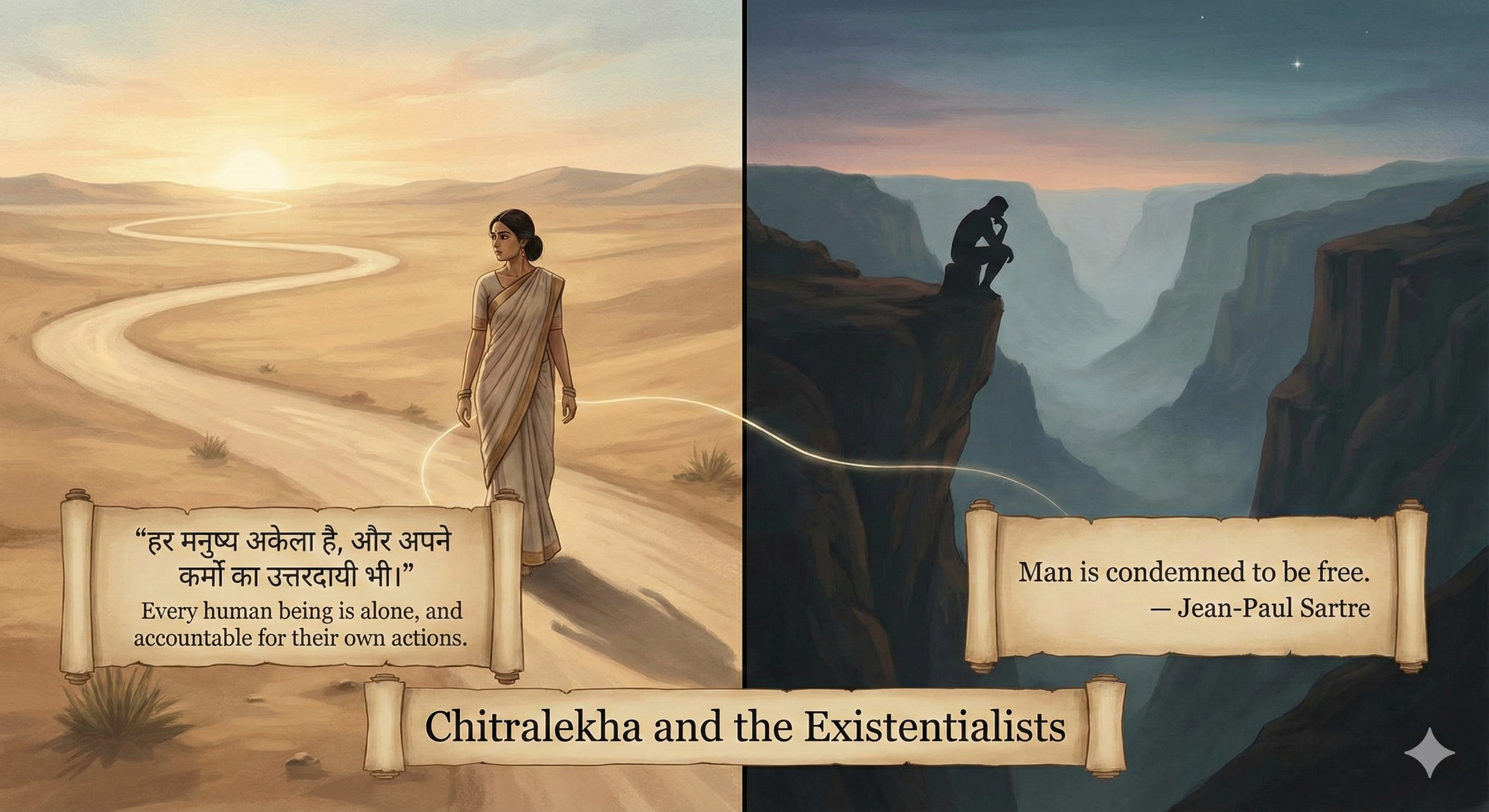
Chitralekha Part VI - The Solitude of Choice
“हर मनुष्य अकेला है, और अपने कर्मों का उत्तरदायी भी।” Every human being is alone, and accountable for their own actions. That line appears late in the book, almost hidden in a quiet dialogue, but it struck me like a bell. It’s the point where…
Continue reading...
Chitralekha Part V - In the Company of the Stoics
“हम अपने कर्मों के स्वामी हैं, परिस्थितियों के नहीं।” We are masters of our actions, not of our circumstances. I didn’t think a Hindi novel from 1934 could remind me of Marcus Aurelius — a Roman emperor writing to himself nearly two thousand years earlier.
Continue reading...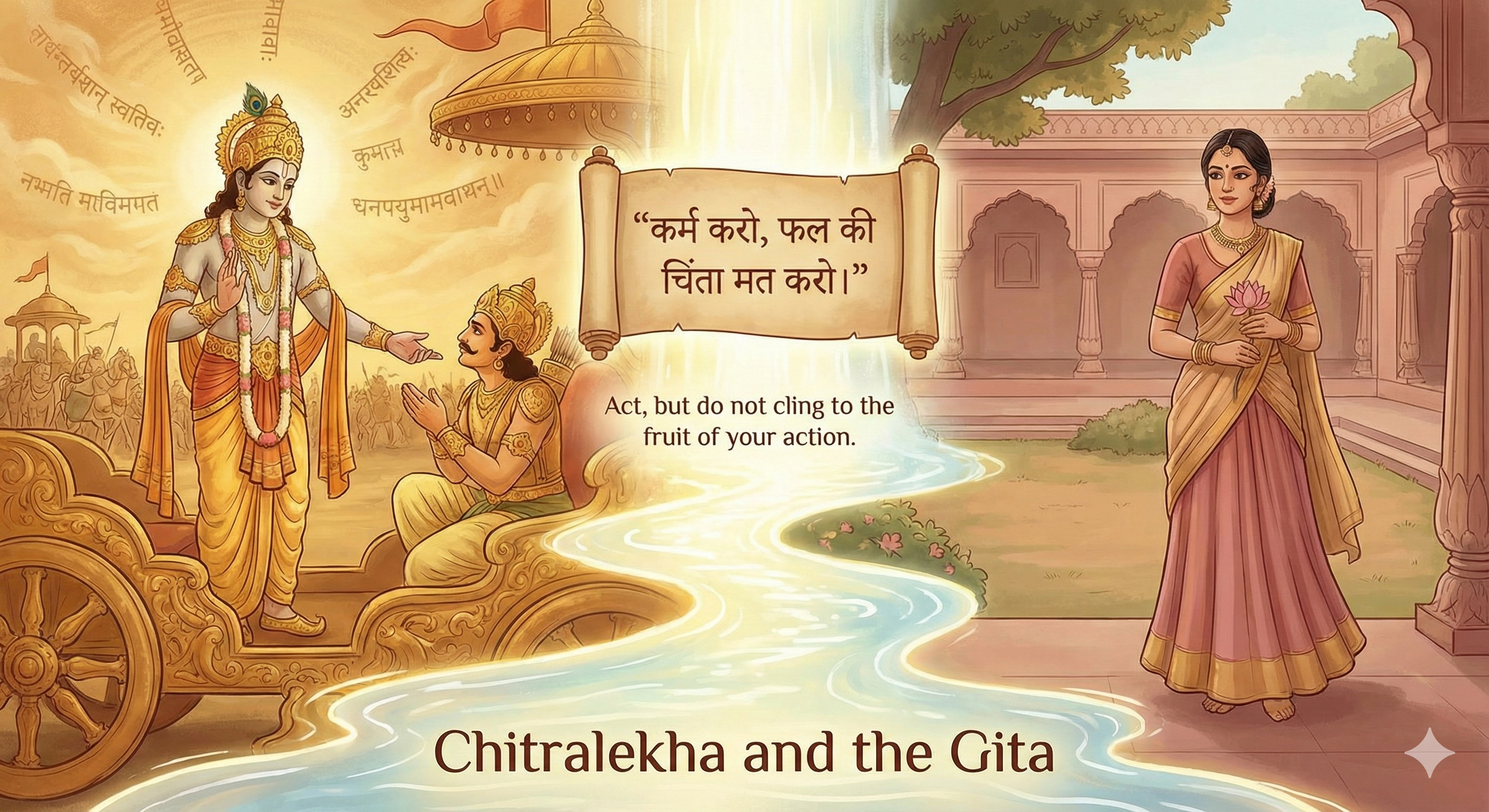
Chitralekha Part IV - In the Company of the Gita
“कर्म करो, फल की चिंता मत करो।” Act, but do not cling to the fruit of your action. It’s a line we all know — the heartbeat of the Bhagavad Gita. We hear it so often that it risks becoming background noise, a moral slogan…
Continue reading...