The Quiet Weight Of Orders - Part 4 of 4

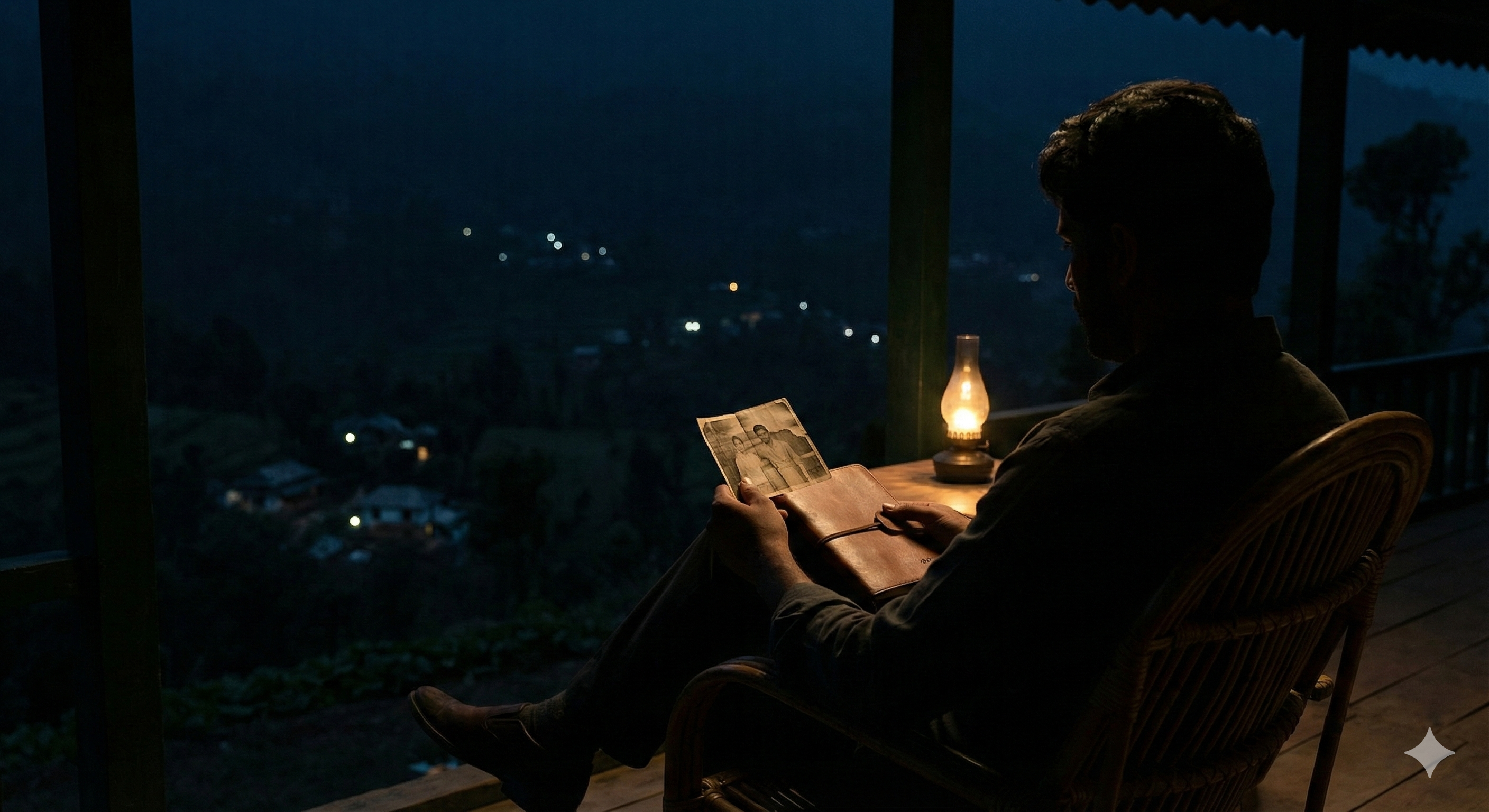
By the time the last light drained from the sky and the valley withdrew into its habitual quiet, the question that had accompanied me all day had grown into something that demanded a fuller honesty. I stepped back onto the verandah with the photograph in my hand, not because I expected to learn anything new from the image, but because it had been the silent thread binding together all the thoughts that had risen and ripened since morning. The lamps in the houses across the slope shone steadily now, small and warm, each one illuminating a story of its own — dinners being prepared, children finishing homework, elders settling themselves against the cold — and yet the stillness of those distant lights only made the gravity of the question more distinct. It had grown larger than the photograph, larger even than the figure of Bhishma or the abstractions of duty and obedience. It belonged to the world we lived in, and to the quiet demands the world made upon those who served it.
I found myself returning again, almost reluctantly, to the contrast between the ancient world and ours. In the old stories, the one who guided the warrior did so with a depth of understanding that commanded respect. If a man was asked to fight, he was told why; if he hesitated, he was offered wisdom, not slogans. The charioteer shared the burden of judgement; the commander shared the weight of consequence. But in our time, this symmetry has collapsed. The modern charioteers — the people who give orders, send troops, craft doctrines, and shape national moods — are not figures of moral authority. They are administrators of ambition, custodians of public emotion, men skilled at navigating alliances and optics rather than truth.
And in that realisation lay the heart of the matter: a soldier today may be called to act with a purity of intent that is not reflected in the intent of the one commanding him. He may risk his life for a purpose that has been mixed, diluted, or quietly distorted by motives he will never hear spoken aloud. He may be asked to uphold ideals that those above him do not themselves honour. He may be sent into danger not because justice requires it, but because politics finds it convenient. And this, more than anything else, is what troubles the conscience: the thought that one’s courage — one’s most personal possession, one’s most intimate virtue — could be spent at the behest of someone who has not earned the right to wield it.
As this understanding settled, I felt the weight of Bhishma’s story press closer. He, too, served loyally under men who did not deserve his loyalty. He, too, upheld a vow that had once been noble but had, over time, become a chain. His tragedy was not that he chose wrongly, but that he did not allow himself the freedom to choose at all when the world changed around him. And in that ancient sorrow I sensed a mirror for the modern soldier, who may find himself upholding orders crafted not by sages but by strategists, not by men who carry moral insight but by men who carry electoral timetables, border anxieties, and the endlessly shifting mathematics of power.
The valley was completely quiet now, and in that quiet the question sharpened with a clarity that felt almost physical. How can an army maintain its ideals when the hands that direct it are not guided by ideals? How does a soldier preserve his morality when the reasons for which he is asked to act are tangled in the compromises of politics? How does he justify obedience when obedience is no longer a pathway to justice but a tool that can be shaped by fear, pride, or calculation? And perhaps the most unsettling question of all: what becomes of courage when its direction is not chosen by the one who must bear its consequence?
These were not abstract thoughts; they felt painfully real, shaped by the world’s present character — a world in which nations argue over symbols, in which borders harden and soften at the convenience of leaders, in which soldiers are invoked as proof of resolve even as their individuality is quietly erased. It is a world in which the rhetoric of sacrifice is abundant but the moral seriousness required to justify that sacrifice is often absent. And in that absence lies the danger: that the soldier’s loyalty may be used to fill the void left by the commander’s deficiency.
I remained on the verandah for a long time, the photograph resting on my knee, and the thought that arrived then was the most intimate of all — not an accusation, not a judgement, but a recognition. Throughout the day I had been circling the uneasy feeling that had accompanied me for years, never fully named, never fully dismissed. And now, in the stillness of the night, it stepped forward with a gentleness that made it undeniable. Perhaps this is, in the end, the quiet reason I never sought the uniform. Not because I lacked respect for it, nor because I doubted the dignity of service, but because I could not imagine surrendering my conscience entirely to another’s command — not in this age, not in this world, not under leaders who do not share the weight of the decisions they impose.
It is not a heroic admission. It does not place me above those who serve; if anything, it leaves me humbled by the burden they carry. But it is my truth, discovered not through argument but through a slow day of thought: that obedience, without the steady presence of wisdom at its helm, becomes a dangerous virtue. And that I am, perhaps by temperament, unwilling to gamble my moral agency on the judgement of men who may treat morality as an instrument rather than an anchor.
I folded the photograph and slipped it back into the notebook. The valley lay quietly in the darkness, the lamps fading one by one as families settled into rest. I felt a sense of completion — not of resolution, for the question would remain with me, I knew — but of recognition. Some thoughts ask us to live with them, not to silence them, and this was one of those thoughts. It would walk with me, as it had walked with me all day, not as a burden but as a companion, a reminder that conscience, however quietly it speaks, must not be surrendered too easily in a world where the chariots are no longer driven by those who understand the sacredness of the path.
You should also read:
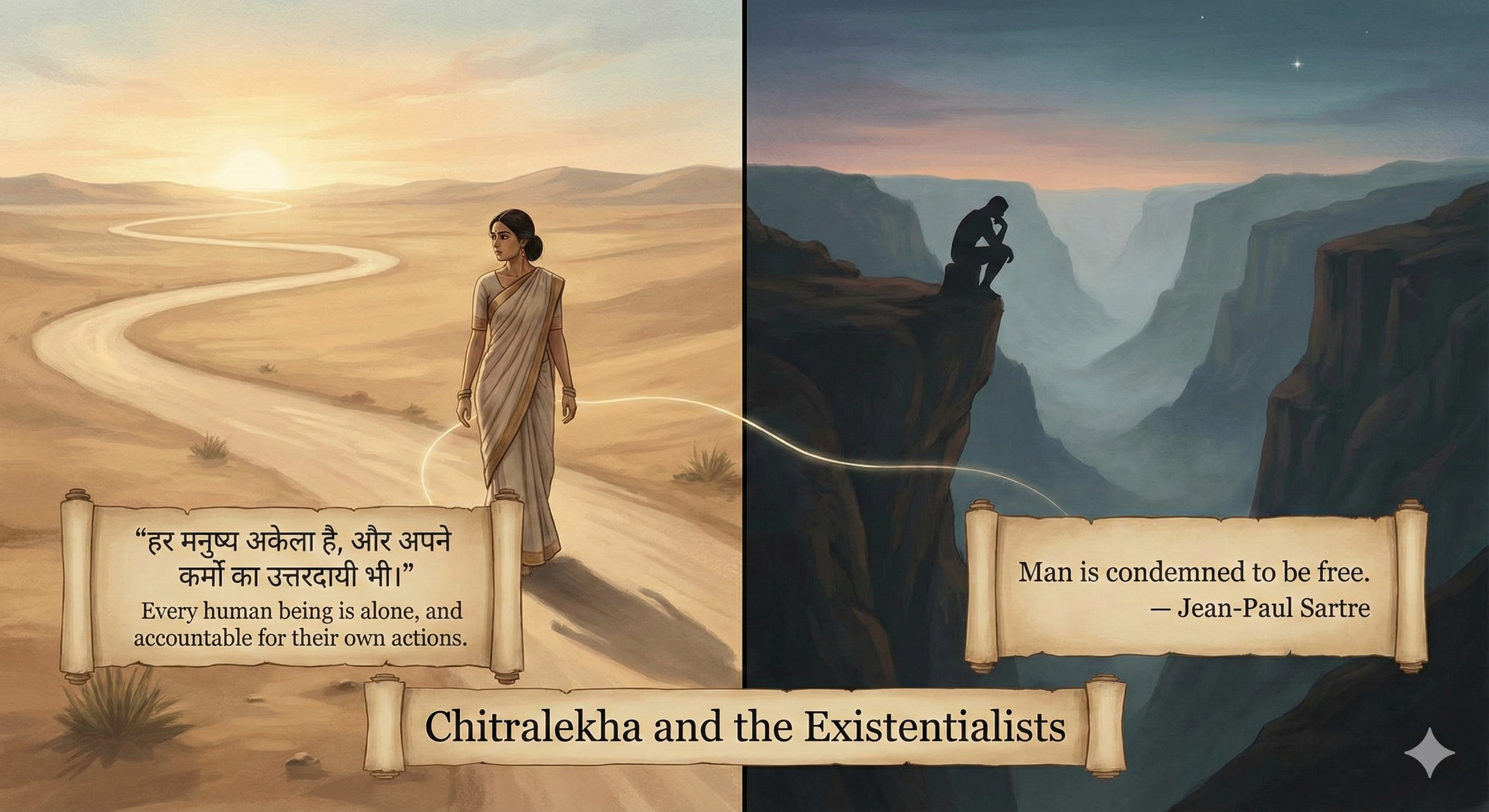
Chitralekha Part VI - The Solitude of Choice
“हर मनुष्य अकेला है, और अपने कर्मों का उत्तरदायी भी।” Every human being is alone, and accountable for their own actions. That line appears late in the book, almost hidden in a quiet dialogue, but it struck me like a bell. It’s the point where…
Continue reading...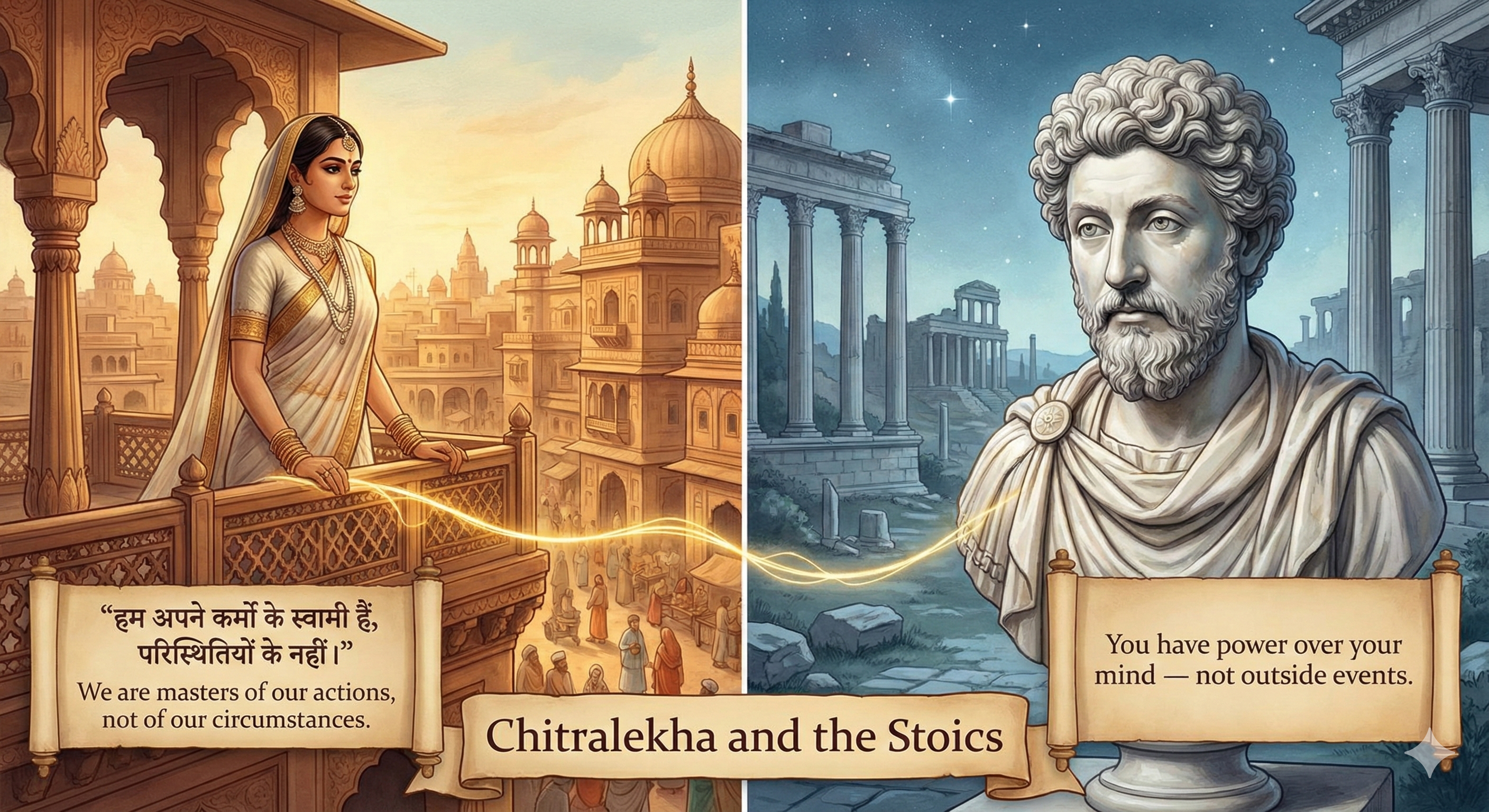
Chitralekha Part V - In the Company of the Stoics
“हम अपने कर्मों के स्वामी हैं, परिस्थितियों के नहीं।” We are masters of our actions, not of our circumstances. I didn’t think a Hindi novel from 1934 could remind me of Marcus Aurelius — a Roman emperor writing to himself nearly two thousand years earlier.
Continue reading...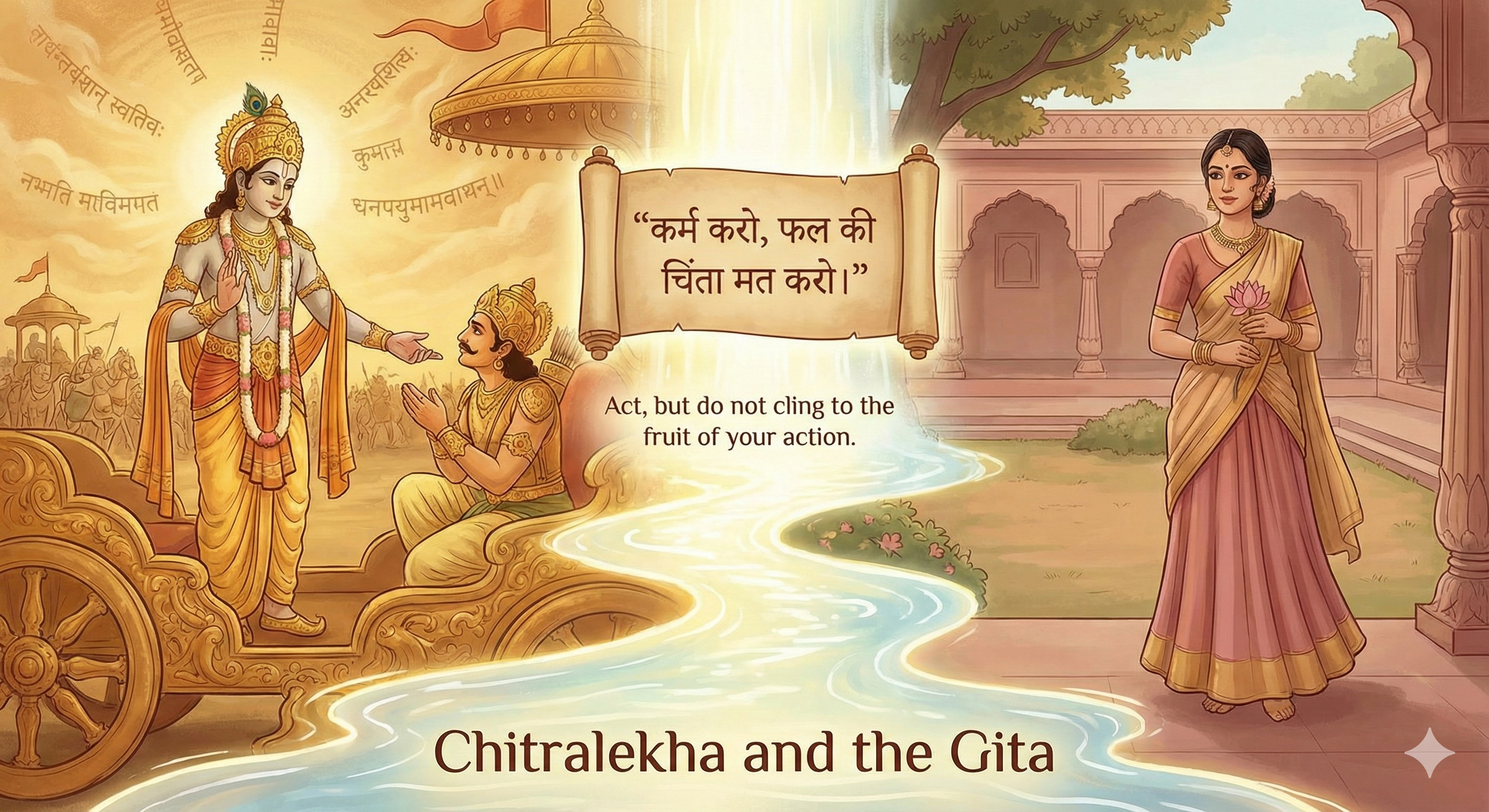
Chitralekha Part IV - In the Company of the Gita
“कर्म करो, फल की चिंता मत करो।” Act, but do not cling to the fruit of your action. It’s a line we all know — the heartbeat of the Bhagavad Gita. We hear it so often that it risks becoming background noise, a moral slogan…
Continue reading...